
Turquoise Jewelry: History, Meaning & Design | Manjusha Jewels
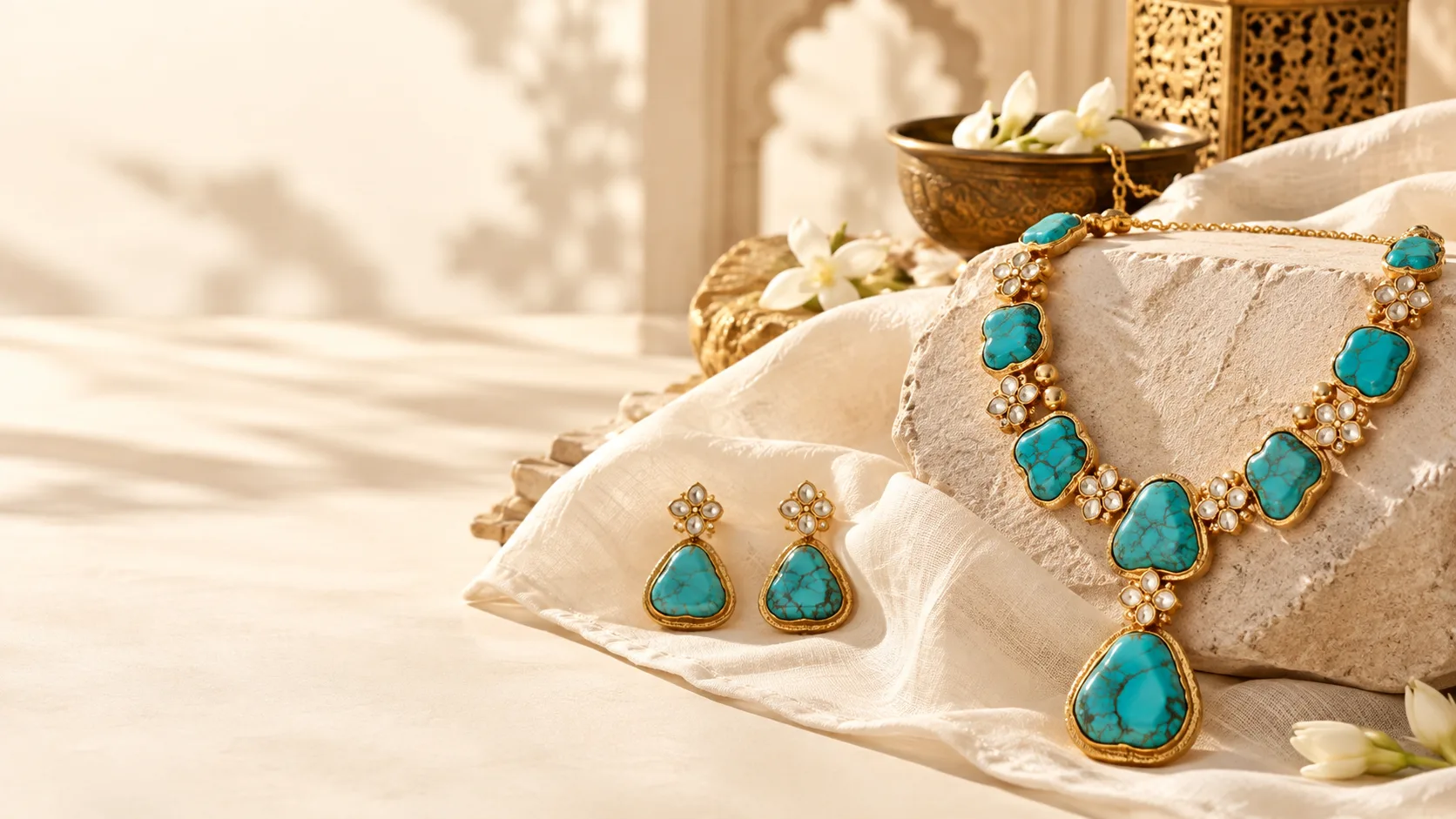
There’s a particular blue that stops me every time, no matter how many pieces I’ve set with it over the years. It’s turquoise — not the cool, clinical blue of a swimming pool, but something warmer and more alive, with veins of matrix running through it like a map of somewhere you’ve never been.
I didn’t choose turquoise for Manjusha because it was trendy. I chose it because it’s one of the oldest stones in the world, and every culture that has ever touched it seems to agree on the same thing: it’s a stone that’s meant to travel with you.
A Stone With Well-Worn Roads
Long before turquoise showed up in a Manjusha collection, it was already crossing continents. Persian royalty prized it for centuries. Mughal courts inlaid it into daggers and thrones. Turquoise traveled the old trade routes from Persia and the Sinai into the treasuries of Indian rulers, where it was set alongside rubies and emeralds in a way that always struck me as slightly rebellious — this humble, opaque stone holding its own next to precious gems worth a hundred times more.
I love that about turquoise. It has never needed to compete. It simply insists on being noticed.
For a deeper look at turquoise’s history, origins, and gemstone characteristics, explore the GIA’s guide to turquoise.
What Drew Me to Turquoise
I remember the first time I really looked at a piece of raw turquoise, rather than a finished, polished cabochon. The matrix running through it — those dark, spidery lines of host rock — looked less like an imperfection and more like a signature.
No two stones are ever the same, which means no two pieces I make with it are either.
That’s actually one of the hardest and most rewarding parts of working with turquoise. You can’t force a design onto it. You have to let the stone’s own pattern decide where the eye should land.
Designing With Turquoise
In the studio, turquoise asks to be set simply. I gravitate toward bezel settings in 22k gold-plated sterling silver, because gold does something wonderful to that particular blue — it warms it, the way sunlight warms a desert sky just before evening.
I love pairing it with coral or carnelian, stones with a similar history of traveling the old trade routes into Indian royal jewelry. There’s something satisfying about putting them back together, the way they might have sat side by side in a treasury a century ago.
Turquoise Necklaces for Everyday Elegance
A single turquoise pendant on a long chain has become one of my quiet favorites — understated during the day, but it catches the light beautifully at night. It’s the kind of piece a woman forgets she’s wearing until someone asks where she found it.
A Stone for Everyday Courage
There’s an old belief, common across many of the cultures that first prized turquoise, that the stone was protective — that it watched over travelers, guarded against harm, and even changed in appearance to warn its wearer of danger.
I don’t design with superstition in mind, but I understand the impulse behind that belief. Turquoise has always felt, to me, like a stone you’d want with you when you were about to do something a little brave.
That’s really what I hope for the women who wear Manjusha. Not that the stone protects them, exactly, but that it reminds them of their own nerve.
Frequently Asked Questions About Turquoise Jewelry
Q1: Why does Manjusha Jewels use turquoise?
Turquoise has a centuries-long history in Persian, Mughal, and Indian royal jewelry, and its natural variation means every piece is one of a kind. It reflects Manjusha’s philosophy of letting each stone’s character lead the design.
Q2: What metal does Manjusha set turquoise in?
Manjusha’s turquoise pieces are typically set in 22k gold-plated sterling silver, which brings out the warmth in the stone’s blue tones.
Q3: How should I care for turquoise jewelry?
Turquoise is a relatively soft, porous stone, so it’s best to avoid perfume, lotion, and prolonged water exposure. Store it separately from harder gemstones to prevent scratching, and wipe it gently with a soft cloth after wearing.
Q4: Does turquoise pair well with other gemstones?
Yes. Turquoise is traditionally paired with coral and carnelian in Indian and Persian jewelry, a combination Manjusha often revisits in its own designs.
Q5: Is every piece of turquoise different?
Yes. The matrix — the veining of host rock running through the stone — varies from piece to piece, which means no two turquoise pieces from Manjusha will ever look quite the same.
Discover More Jewelry Stories
Explore more stories from Manjusha Jewels, including jewelry inspiration, gemstone stories, design journeys, and the craftsmanship behind each piece.