
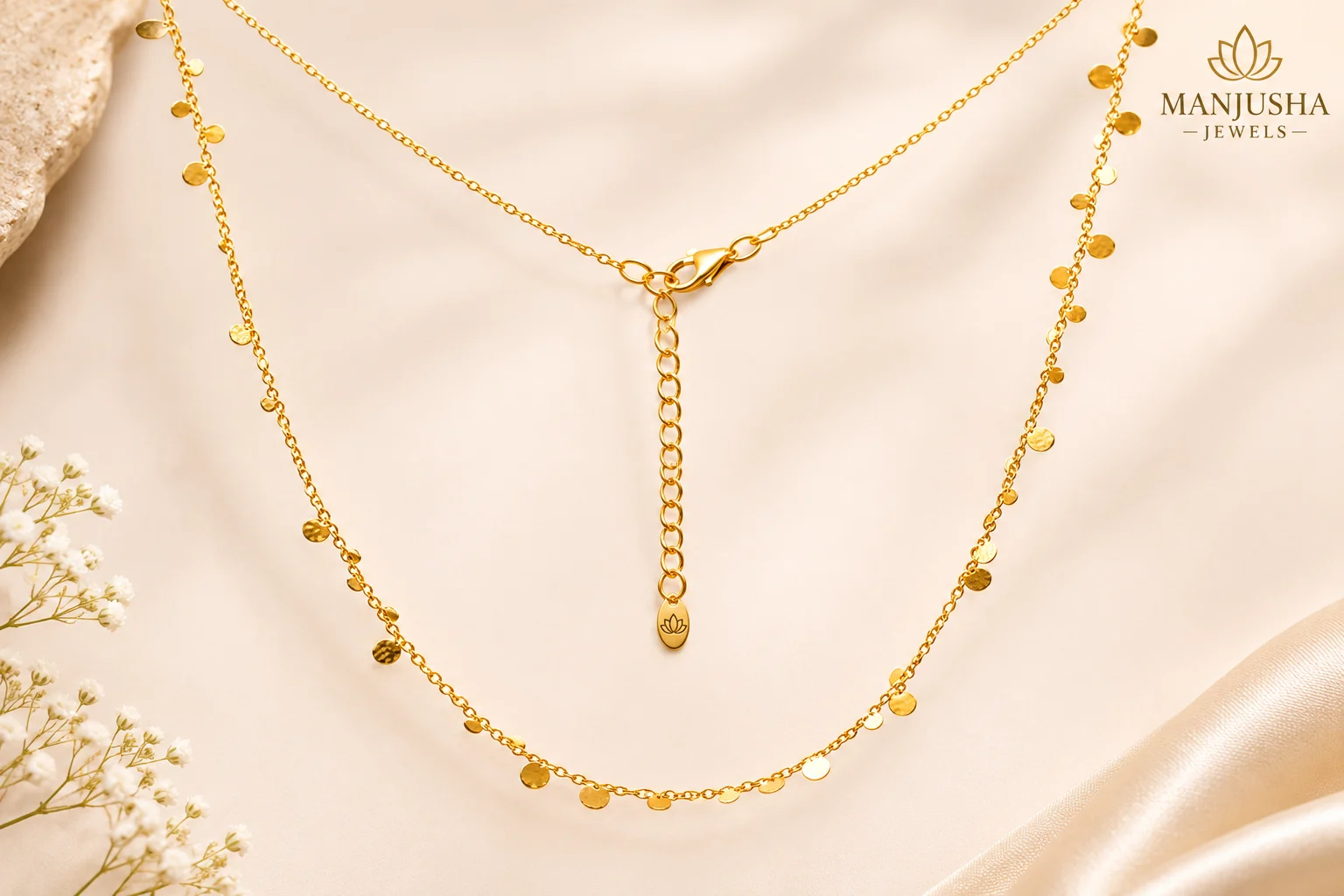
Walk through any Manjusha collection, onyx or aqua chalcedony, labradorite or citrine, and one thing stays constant underneath: rich, unmistakably warm 22K gold plating. For designer Jyotsna “Joey” Singh, it is not a styling choice. It is a non-negotiable, the one finish she refuses to substitute no matter how a design evolves.
To understand why, you have to understand what 22K gold has meant in India for thousands of years, and what it meant in the home where Joey grew up.
Why 22K Gold Plating Is Non-Negotiable for Manjusha
Gold is measured in karats, a scale that describes how much of a piece is pure gold out of 24 parts:
- 24K is essentially pure gold, about 99.9 percent.
- 22K is about 91.67 percent gold.
- 18K is 75 percent gold.
- 14K is about 58.3 percent gold.
The more gold in the mix, the deeper and more buttery the yellow. Lower-karat golds, common in much Western jewelry, contain more of other metals and can look paler or slightly cooler. 22K gold has a distinctive warmth that people who grew up around Indian jewelry recognize instantly. It is the color of family weddings and festival mornings.
That color is what Joey wanted every Manjusha piece to carry. By finishing each design in genuine 22K gold plating, she gives the whole collection the same rich glow, whether the stone at its center is a deep garnet or a pale aqua chalcedony.
The History of 22K Gold in Indian Tradition
In India, gold has carried meaning far beyond its shine for thousands of years. The Rig Veda, one of the world’s oldest surviving texts, refers to gold as a symbol of prosperity and light, and Indian families have marked weddings, births, and milestones with it ever since.
Gold is woven into the calendar, too. Many families buy gold on Akshaya Tritiya in spring and on Dhanteras, the first day of Diwali, as an auspicious start to a new season or year. Gold given at these moments is not simply a purchase. It is a blessing.
Weddings are where gold’s meaning is clearest. A bride traditionally receives gold as she joins her husband’s family, and the pieces she is given are meant to be kept, added to, and eventually passed down. In many families, this jewelry is considered the woman’s own wealth and security. Jewelry, in this tradition, is inheritance, not just adornment.
Purity matters so much that it is marked directly on the metal. In India, 22K jewelry is commonly stamped “916,” shorthand for its roughly 91.6 percent gold content, and government hallmarking helps buyers trust what they are paying for. Families often check that small number before a wedding purchase as carefully as they check the design. It is a reminder that in Indian tradition, gold is both beauty and security, something to admire and something to rely on.
That is why 22K became the standard for so much Indian jewelry. It is pure enough to carry real value and that unmistakable color, while still holding a shape well enough to be worked into intricate designs.
From Royal Heritage to Modern Design
That is the tradition Joey grew up inside, surrounded by her grandfather Maharaja Bhupinder Singh’s extraordinary collection and generations of family gold meant to last. As a child, she saw gold not as a trend but as something that held a family’s history: pieces worn at one wedding and then another, reshaped for new generations, and remembered for the people who wore them.
When she began designing, she wanted to carry that feeling into jewelry that fit a modern, Western wardrobe: pieces you could wear to work on a Tuesday, not only to a wedding. The challenge was keeping the warmth and meaning of high-karat gold while making jewelry that was light, comfortable, and accessible enough to wear every day.
Sterling Silver, 22K Gold Plating, and Natural Gemstones: Built to Last
Her answer is the combination that defines every Manjusha piece today:
- A sterling silver base. Sterling is 92.5 percent pure silver, stamped “925,” and a precious metal in its own right. It gives each design a solid, quality foundation.
- Genuine 22K gold plating. A layer of 22K gold is bonded to the sterling silver surface, giving each piece the depth and warmth of high-karat gold.
- Natural gemstones. Every stone, from citrine and garnet to labradorite and turquoise, is natural.
This approach lets Joey create bolder, more expressive designs than would be practical in solid 22K gold, at prices that make it possible to build a collection rather than own a single piece. It also keeps the jewelry comfortable for everyday wear.
Caring for 22K Gold-Plated Jewelry
Plated jewelry rewards a little care. Put your jewelry on last, after lotions, perfume, and hairspray, and take it off first. Remove it before swimming, bathing, exercising, or cleaning. Wipe each piece with a soft, dry cloth after wearing, and store pieces separately so they do not scratch each other. Avoid jewelry dips and abrasive polishing cloths.
It is a quiet thread, but it is the one that ties every Manjusha piece, ancient stone or modern silhouette, back to where the whole collection began.
Explore the Full Manjusha Collection
From everyday dots and chains to statement pendants, every design shares the same warm 22K gold-plated finish and natural gemstones at its heart.
Explore the full collection at manjushajewels.com/collections/all
Frequently Asked Questions
Q1: Is Manjusha jewelry solid 22K gold?
No. Every piece is built on a sterling silver base, finished with genuine 22K gold plating, and set with natural gemstones.
Q1: What does “22K gold” mean?
22K gold is about 91.67 percent pure gold. It is prized in Indian jewelry for its rich, warm color.
Q2: Why does Manjusha use gold plating instead of solid gold?
22K gold plating over sterling silver gives each design the warmth and heritage look of high-karat gold in a form that is lighter, more comfortable, and more accessible for everyday wear.
Q3: Is 22K gold-plated jewelry durable?
With reasonable care, such as avoiding chemicals, moisture, and abrasion, 22K gold plating holds up well for regular wear.
Q4: Why is gold significant in Indian tradition?
Gold has symbolized prosperity in India since the Rig Veda. It is given at weddings, bought on auspicious days, and passed down as family inheritance.
Q5: How is gold-plated jewelry different from solid gold?
Gold-plated jewelry has a base metal, in Manjusha’s case sterling silver, with a layer of gold bonded to the surface. Solid gold is gold throughout.
Gold hallmarking helps consumers understand the purity and fineness of precious metal jewelry. Read more about India’s official gold hallmarking system