
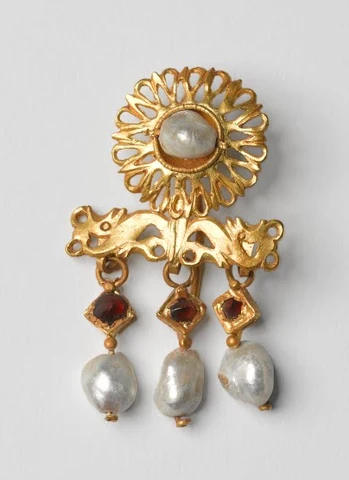
Pearls: The Timeless Gem Born From Nature
Few gemstones can claim a story as closely connected to nature as the pearl.
Unlike most gemstones, pearls are not formed deep inside rocks. They begin their journey inside a living mollusk, where nature slowly builds layer after layer of nacre around an irritant.
The result is something remarkable: a luminous gem created without being cut or polished from a larger stone.
For thousands of years, that natural process has fascinated people around the world—and pearls continue to inspire jewelry designers today.
Why Pearls Are So Special
Pearls have been treasured for thousands of years and have long been associated with elegance, wealth, beauty, and royalty.
Before modern pearl cultivation existed, finding a natural pearl was a matter of chance. Divers had to search beneath the ocean for oysters that might contain one, making the process difficult, dangerous, and unpredictable.
A pearl could take years to develop, and there was no guarantee that an oyster would contain one at all.
That rarity helped make natural pearls some of the most coveted treasures in history.
Pearls and Royalty
Throughout history, pearls have appeared in the jewelry collections of royalty and other influential figures.
Ancient civilizations valued them for their unusual glow and natural beauty. Pearls were used in crowns, necklaces, earrings, ceremonial objects, and elaborate royal adornments.
Historical figures such as Cleopatra have long been associated with legendary stories involving pearls, while pearls also became an important part of European and Asian royal jewelry traditions.
Their association with status eventually made the pearl a symbol of sophistication and prestige.
How a Natural Pearl Is Created
The formation of a pearl is one of nature’s most fascinating processes.
When an irritant enters a mollusk, the animal protects itself by covering the foreign material with layers of nacre, the same substance that gives many shells their distinctive inner shine.
Over time, layer after layer accumulates.
Eventually, those layers form a pearl.
The process is slow, delicate, and entirely dependent on the environment in which the mollusk lives.
From Irritant to Gemstone
What begins as something unwanted becomes something beautiful.
That transformation is part of what makes pearls so fascinating.
Instead of removing an imperfection, nature surrounds it with layer upon layer of material until something luminous is created.
For jewelry lovers and designers, there is an almost poetic quality to that process.
The Rise of Cultured Pearls
As demand for natural pearls increased, pearl-producing oyster populations faced significant pressure.
The difficulty and unpredictability of finding natural pearls encouraged researchers and entrepreneurs to search for a way to reproduce the process under controlled conditions.
One of the major milestones came from Japanese entrepreneur Mikimoto Kōkichi, whose work helped establish the modern cultured pearl industry.
In the late 19th century, Mikimoto and his collaborators developed techniques for encouraging Akoya oysters to produce pearls by intentionally introducing a nucleus or irritant.
The oyster responds by depositing nacre around it.
The basic principle mirrors what happens naturally, but under carefully managed conditions.
Why Cultured Pearls Matter
Cultured pearls made pearl jewelry much more accessible.
Instead of relying entirely on the rare chance of discovering a naturally occurring pearl, producers could cultivate pearls and develop them in controlled environments.
Today, cultured pearls make up the vast majority of pearls used in commercial jewelry.
They are available in many varieties, colors, shapes, and sizes, giving designers far more creative possibilities.
The Beauty of Imperfect Pearls
When most people imagine a pearl, they probably picture a perfectly round, smooth, white sphere.
But pearls don’t always look that way.
Some develop unusual shapes, uneven surfaces, elongated forms, or organic silhouettes.
These are commonly known as baroque pearls.
Rather than seeing their irregularity as a weakness, many jewelry designers celebrate it.
Why Baroque Pearls Are So Appealing
No two baroque pearls are exactly alike.
Their unique shapes give jewelry a more organic and individual character. Instead of looking perfectly manufactured, they retain visible evidence of their natural formation.
That individuality is one reason baroque pearls continue to attract attention among contemporary jewelry lovers.
Their organic appearance can work beautifully with both classic and modern designs.
What Are Keshi Pearls?
Another interesting variety is the Keshi pearl.
Keshi pearls are typically formed without a traditional bead nucleus and can develop naturally during the pearl-cultivation process. Because of the way they form, they are often small and irregular, with distinctive shapes and strong nacreous luster.
Their organic character makes them particularly interesting for designers who enjoy working with natural variations.
Pearls and the Manjusha Jewels Design Philosophy
Pearls have a special place in the design world, and they have long been part of Manjusha Jewels.
Designer Jyotsna “Joey” Singh has a particular appreciation for baroque and Keshi pearls because of their natural character.
Rather than treating irregularity as something that needs to be corrected, Joey embraces it.
Her designs explore how naturally formed pearls can be incorporated into jewelry that feels elegant without being overly formal.
Inspired by Nature and Heritage
Joey’s creative work draws from several sources, including nature, Indian culture, history, and her family’s connection to Indian royal jewelry.
Her approach isn’t about simply reproducing elaborate historical pieces.
Instead, she looks at traditional forms and reinterprets them for modern life.
The result is jewelry that can feel connected to history while remaining easy to wear today.
From Royal Grandeur to Everyday Jewelry
The jewelry associated with Maharaja Bhupinder Singh of Patiala is an important part of Joey’s family heritage.
His famous collection included extraordinary pieces created by some of the world’s most renowned jewelers, including Cartier.
The scale and extravagance of royal jewelry from that era were extraordinary.
Joey’s approach is different.
She takes inspiration from the visual language of that heritage and translates it into pieces designed for contemporary women.
Pearls, with their natural elegance and versatility, fit beautifully into that philosophy.
Why Pearls Remain Timeless
Fashion changes constantly, but pearls continue to appear in jewelry collections decade after decade.
Part of their appeal comes from their versatility.
A simple pearl earring can feel understated and classic.
A dramatic baroque pearl necklace can make a bold contemporary statement.
A delicate pearl bracelet can work with everyday clothing.
That ability to adapt is one reason pearls have remained relevant for generations.
A Gem That Doesn’t Need Perfection
Perhaps the most beautiful lesson pearls offer is that perfection isn’t always necessary for something to be beautiful.
A baroque pearl may have an unusual curve.
A Keshi pearl may have an unexpected shape.
A natural pearl may contain subtle variations in color or surface.
Those differences are what make each pearl individual.
For a jewelry designer, those natural characteristics aren’t limitations—they are opportunities.
Frequently Asked Questions
Q1: Why are pearls considered gemstones?
Pearls are commonly classified as organic gemstones because they are produced by living mollusks rather than formed through geological processes like diamonds, rubies, or sapphires.
Q2: Are natural pearls still available today?
Natural pearls do exist, but they are extremely rare compared with cultured pearls. Most pearls used in modern jewelry are cultured.
Q3: What is a cultured pearl?
A cultured pearl is produced when humans introduce a nucleus or other irritant into a mollusk and encourage it to form nacre around the material. The resulting pearl is created through a natural biological process within the mollusk.
Q4: What are baroque pearls?
Baroque pearls are pearls with irregular, non-spherical shapes. Their unusual forms are part of their natural character and make every pearl distinctive.
Q5: Are baroque pearls valuable?
The value of a baroque pearl depends on factors such as size, luster, surface quality, color, shape, nacre quality, and overall appeal. Irregular shape does not automatically mean lower quality.
Q6: What are Keshi pearls?
Keshi pearls are generally small, nacre-rich pearls that form without a traditional bead nucleus. They are often appreciated for their organic shapes and distinctive luster.
Q7: Why does Manjusha Jewels use baroque pearls?
Manjusha Jewels designer Jyotsna “Joey” Singh appreciates the individuality and natural beauty of baroque pearls. Their organic forms allow her to create jewelry that feels contemporary while remaining connected to nature.
Q8: Are pearls suitable for everyday jewelry?
Yes. Pearls can be incorporated into many types of jewelry, from simple everyday earrings to statement necklaces. However, because pearls are relatively delicate compared with many gemstones, proper care is important.
Conclusion: Beauty Created by Nature
A pearl is a beautiful reminder that nature doesn’t always follow a perfect pattern.
Inside a small mollusk, something unexpected can slowly become something extraordinary.
That transformation—from irritation to nacre, from layers to luminosity—is part of what has made pearls so fascinating for thousands of years.
At Manjusha Jewels, that natural individuality continues to inspire our approach to design.
From classic pearls to expressive baroque and Keshi varieties, each one brings its own shape, character, and story.
For us, that is the true beauty of pearls.
They don’t have to be identical to be beautiful. They simply have to be themselves.
Disclaimer
This article is provided for general educational and informational purposes. Historical references, pearl terminology, cultivation methods, and gemstone characteristics are presented as general background and may vary depending on the specific pearl variety and source. Pearl appearance, quality, value, and durability can differ considerably. For information about a particular Manjusha Jewels product, please refer to its individual product description and care guidance.
For more information about natural and cultured pearls, their unique characteristics, and their use in fine jewelry, explore the CIBJO Guide to Natural and Cultured Pearls.
With warmth,
The Manjusha Jewels Family