
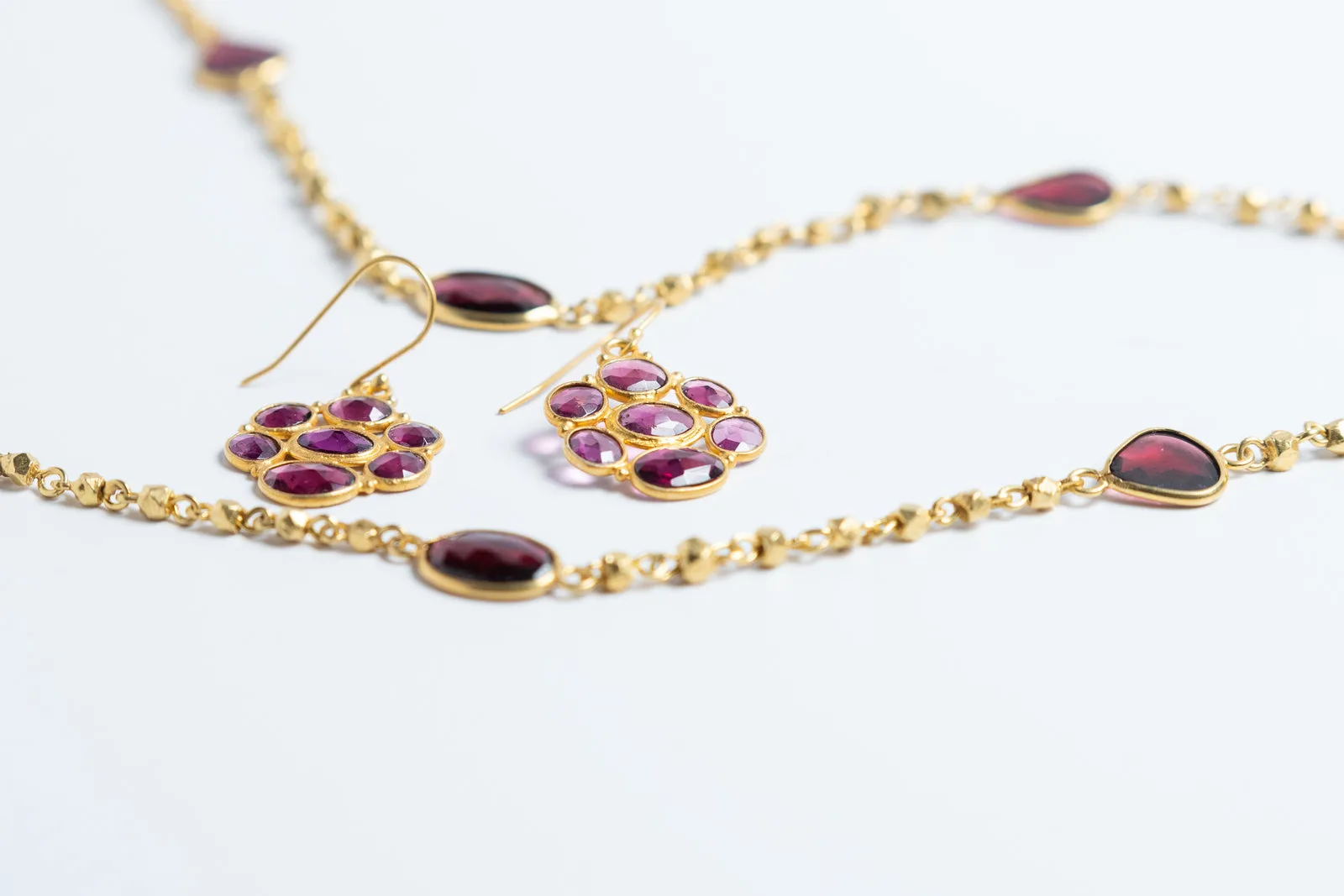
Gleaming Garnet: The Gemstone Behind Manjusha Jewels
Every gemstone has a story.
Some are admired for their rarity. Others are loved for their color, history, symbolism, or the way they capture light.
For Manjusha Jewels designer Jyotsna “Joey” Singh, gemstones have always been much more than beautiful materials.
They were part of her earliest connection to jewelry and to her family’s remarkable history.
Among all the gemstones that have influenced her work, one has remained especially close to her heart: garnet.
Where Joey’s Love for Gemstones Began
Joey’s fascination with gemstones began early in life.
Growing up with a family connection to India’s royal heritage meant that stories of extraordinary jewelry and precious stones were never completely distant.
Those memories eventually became part of her creative journey.
When Joey began designing jewelry, incorporating gemstones into her work felt natural. Their colors, textures, natural variations, and history offered endless possibilities.
But garnet quickly became one of her favorites.
Why Garnet Stands Out
Garnet has a distinctive warmth that makes it immediately recognizable.
Many people picture garnet as a deep red gemstone, but the garnet family is far more diverse than that.
Depending on its variety and chemical composition, garnet can appear in shades of red, orange, yellow, green, purple, and other colors.
That range makes garnet particularly exciting for jewelry designers.
The Fascinating Origin of the Word Garnet
The story of garnet begins with its name.
The modern word is connected to historical terms such as the Latin granatus, which is associated with the appearance of pomegranate seeds.
The connection makes sense when you look at certain garnet crystals.
Their rich red color and resemblance to pomegranate seeds created an association that has continued through language and history.
The Spanish word granada, meaning pomegranate, is another interesting reminder of that connection.
A Gemstone With a Natural Connection
Garnets are not a single mineral species.
The name refers to a group of minerals that share a similar crystal structure but can differ significantly in chemical composition.
That variation helps explain why garnets can appear in such a broad range of colors.
For jewelry lovers, it means that “garnet” doesn’t necessarily mean only one look.
Garnet Through Ancient History
Garnet has been admired for thousands of years.
Ancient civilizations, including the Greeks, Egyptians, and Romans, used and valued garnet in jewelry and decorative objects.
Its rich color made it especially attractive for adornment, while cultural traditions gave gemstones additional symbolic meanings.
Garnet also appears in stories and historical references connected with the ancient world.
The Pomegranate and Greek Mythology
The visual relationship between garnet and pomegranate also creates an interesting connection with Greek mythology.
The story of Persephone and her time in the underworld includes the famous pomegranate.
According to the myth, Persephone ate pomegranate seeds while in the underworld, an act that ultimately connected her to Hades and contributed to the explanation of the changing seasons.
While garnet itself isn’t the pomegranate, the resemblance between the gemstone’s crystals and the fruit’s seeds has made the comparison especially memorable.
Garnet Isn’t Always Red
One of the most interesting things about garnet is its variety.
Red garnets are perhaps the most familiar, but garnet can occur in several other colors.
Green garnets can be found in locations including Tanzania, while yellow varieties have been associated with Mali. Some garnets can also display unusual purple or color-changing characteristics.
The exact color depends on the garnet variety and its chemical composition.
A Rainbow of Garnet Colors
Some examples of garnet varieties include:
- Almandine – commonly found in deep red to reddish-brown shades
- Pyrope – often associated with rich red tones
- Spessartine – known for orange to reddish-orange colors
- Grossular – can occur in green, yellow, orange, and other shades
- Andradite – includes varieties known for green and yellow-green colors
- Uvarovite – typically associated with vibrant green crystals
This variety is one reason garnet remains such an interesting gemstone for collectors and jewelry designers.
The Symbolism Associated With Garnet
Throughout history, gemstones have been given symbolic meanings by different cultures.
Garnet has often been associated with ideas such as passion, vitality, protection, strength, and friendship.
Some modern crystal and spiritual traditions also attribute various energetic or healing properties to garnet.
These beliefs are cultural and personal rather than scientifically established, but they remain part of the broader story surrounding the gemstone.
For Joey, the appeal of garnet comes from a combination of its visual character, history, and the personal meaning she associates with gemstones.
Garnet in Manjusha Jewels Designs
Garnet has appeared in both legacy and contemporary Manjusha Jewels designs.
Its rich color works beautifully with gold and can create jewelry that feels sophisticated without becoming overly formal.
The gemstone can be used as a central focal point or combined with other stones to create contrast.
From Heritage to Contemporary Jewelry
Joey’s design philosophy is influenced by her Indian heritage and her family’s connection to royal jewelry.
But her goal isn’t simply to reproduce elaborate historical designs.
Instead, she looks for ways to reinterpret the beauty of traditional jewelry for modern life.
Garnet works particularly well within that approach.
Its historical character gives it depth, while its natural color allows it to fit easily into contemporary designs.
Why Garnet Is a Wonderful Choice for January Birthdays
Garnet is traditionally recognized as the birthstone for January.
That makes it a popular choice for birthday jewelry and meaningful gifts.
A garnet ring, necklace, bracelet, or pair of earrings can combine personal significance with the timeless appeal of a natural gemstone.
A Meaningful Gift Beyond Birthdays
You don’t need to be born in January to appreciate garnet.
Its deep colors and rich history make it suitable for anniversaries, milestones, celebrations, or simply as a personal addition to a jewelry collection.
The best gemstone is often the one that feels meaningful to the person wearing it.
Caring for Garnet Jewelry
Like all gemstones, garnet jewelry benefits from thoughtful care.
Although many garnets are suitable for regular wear, hardness and durability vary between garnet varieties.
To help keep garnet jewelry looking its best:
- Store pieces separately to reduce scratches.
- Avoid exposing jewelry to harsh chemicals.
- Remove jewelry before activities that could cause impact or abrasion.
- Clean gently using appropriate jewelry-care methods.
- Follow the specific care recommendations provided for your piece.
When in doubt, professional jewelry cleaning is a safe option.
Frequently Asked Questions
Q1: What is garnet?
Garnet is a group of related minerals that share a similar crystal structure. Garnets can occur in a wide variety of colors, although red is one of the most familiar.
Q2: Is garnet always red?
No. Garnets can be red, orange, yellow, green, purple, and other colors depending on their variety and chemical composition.
Q3: What is garnet’s birthstone month?
Garnet is traditionally recognized as the birthstone for January.
Q4: Why is garnet associated with pomegranates?
Some garnet crystals resemble the rich red color and clustered appearance of pomegranate seeds. The name garnet is connected to the Latin granatus, which is associated with seeds.
Q5: Where are garnets found?
Garnets are found in many parts of the world. Different varieties have different geographic sources, with important deposits occurring in countries across Africa, Asia, North America, and elsewhere.
Q6: What colors can garnet be?
Depending on the variety, garnet can appear in shades including red, orange, yellow, green, purple, and brown.
Q7: Is garnet a good gemstone for jewelry?
Yes. Many garnet varieties are well suited to jewelry, although durability can vary between types. The appropriate design and care depend on the specific garnet variety.
Q8: Why does Joey Singh like garnet?
Garnet appeals to Joey because of its rich colors, natural character, historical associations, and the way it complements her approach to jewelry design.
Conclusion: A Gemstone With a Story to Tell
Garnet is beautiful at first glance, but its story is what makes it even more fascinating.
Its connection to ancient cultures, its surprising range of colors, its relationship with the pomegranate, and its long history in jewelry all give this gemstone a personality of its own.
For Joey Singh, garnet also carries a personal connection.
It represents the importance of gemstones in her journey as a designer and reflects her appreciation for nature, history, Indian culture, and the artistry of jewelry.
Whether you’re choosing garnet because it is your January birthstone, attracted to its deep color, or simply fascinated by its history, it is a gemstone that offers something beyond its sparkle.
Beautiful in color, rich in history, and naturally distinctive—garnet continues to earn its place among the world’s most captivating gemstones.
Disclaimer
This article is intended for general educational and informational purposes. Gemstone symbolism and traditional meanings can vary between cultures and individuals. References to energetic or healing properties reflect cultural or personal beliefs and should not be considered scientifically proven medical claims. Garnet varieties can differ in color, durability, value, and care requirements. Always refer to the specific product information or consult a qualified jeweler for advice about a particular garnet.
For more information about garnet’s mineral properties and different varieties, explore the Gemological Institute of America (GIA) gemstone guide.
With warmth,
The Manjusha Jewels Family